The Beginning of the End! Course 5 Final

It’s been a good journey but I am also excited to see it coming to an end.  Experimenting with flipping a couple of lessons in my Art 7 classes has been a great way for me to wrap things up. I love the idea of using technology in my room but I’m also very conscious of the fact that I don’t want to take away from the students time to get their hands dirty with the creative process. I’ve found that when I flip a lesson in my class I am actually creating more time for students to get their hands dirty.  Even better is that the time I have created for them to work on their art is also time that I can be standing by to help them when they need a little extra guidance.

When all was said and done I would have to say that I felt the most success with my flipped lesson on negative space.  Take a look.

Yes it takes some time to make the video but I am hoping that as I work with the tools more frequently the process will speed up. Even though making a video is time consuming my goals were met and then some, making it all worth it.

  1. Students had more time in class to complete there work.
  2. Students had their iPads out on there desks and were able to refer to the tutorial for review while working rather than asking me to repeat something.
  3. Because student had access to the tutorial while working they didn’t need as much assistance from me.  This gave me more time to work with students who were needing extra help.
  4. 39 of 42 students had their entry tickets and knew exactly what to do when they entered the class.  It was wonderful to see everyone come in and get straight to work.
  5. I learned a lot about the different tools I used to make the video.
  6. Student understanding of the concepts being taught was much higher than in previous semesters. I can see this because concepts taught in this lesson have been continually used by students when discussing works of art.
  7. Less classroom management was needed because students were not required to listen to me lecture and demonstrate.

As you can see there are many positive outcomes to my flipped experience.  A lot of this is also attributed to the thoughtful planning that went into the lesson.  I did flip another lesson a few weeks after my initial negative space lesson.  I have to admit that this lesson was not as successful.  I believe the reason for this was because the lesson was not one that needed flipping. I did not see a significant different in the outcome of the student work.  I also don’t feel that the technology actually helped to explain the concepts being taught any more clearly than when previously taught. That being said I don’t believe that all lessons should be flipped but flipping the right lesson will get the desired results.

Here is my Ubd framework for planning this project, as well my video explaining a bit more about my process.  I hope my work will give you a little insight into flipping some lessons of your own.


Stop Motion 101

Earlier this year I was given the opportunity to teach a stop motion animation class. I had taught stop motion to 5th graders before but this was to be an entire middle school semester focussing on stop motion animation.  With it being my first time teaching animation on this level there were certainly some ups and downs thought the semester. With that being said I am excited to be teaching it again next year.   I thought I would take this opportunity to share a little about the process we used and what I learned as a rookie.

  1. Start out by making sure that students understand the stop motion process.  It’s good to have an understanding of FPS (frames per second) and how many photos are actually required for each shot.  It’s also important to understand how many small movements happen within just a couple of seconds.  We did this by looking at other simple stop motions and flip books.
  2. Students should work in groups of 2 or 3.  Often times 4 is too many unless you are animating people doing supernatural things.
  3. Have students brainstorm their overall story along with props and materials they will need before they story board. This will help them to get a better grasp on what they might be able accomplish within the time frame they have.
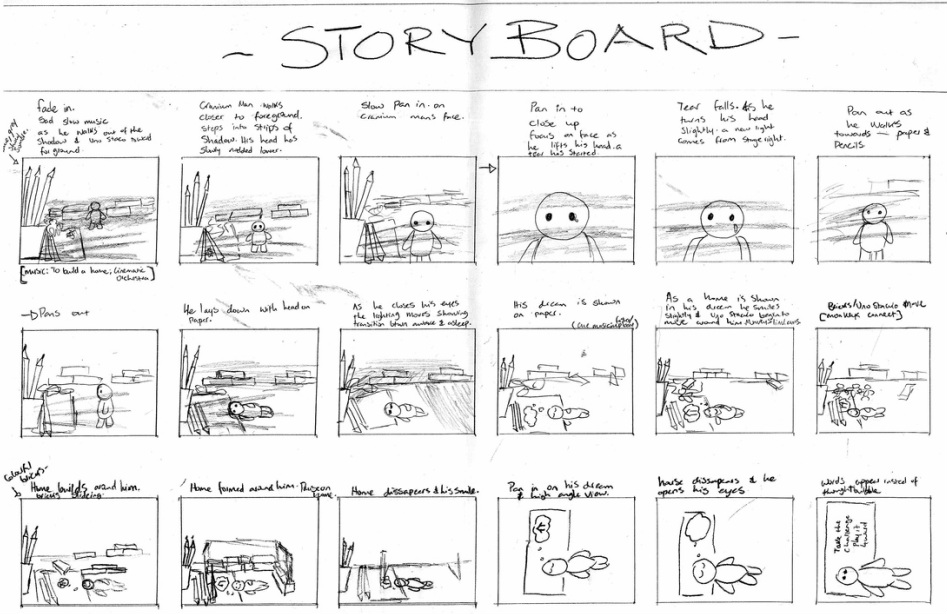
  4. Never underestimate the importance of a detailed story board. If students don’t think through their whole process while storyboarding they are going to struggle when making props and shooting pictures. The groups that were the most successful with there final product had beautiful story boards and those that were not so successful had story boards that were not only extremely minimal in detail but also did not resemble the final product. Students with poorly detailed story boards quickly learned from their shortcomings and were sure to put more thought into the storyboarding process in there next animations.

    Ruth Emma Design
  5. When working on set design often have students look at what they are making though the camera lens to make sure it will fit properly.  Often times students will make props too small and they are not noticeable through the camera.  This makes size and scale extremely important.  Another common issue is that student often make props that will be animated but have not put thought into how to keep the prop stationary for the shooting process.  This is a big issue that needs to be properly thought out before they get to far into the construction of the props.
  6. When shooting your pictures students should all have different roles. One person should be behind the camera and direct and the others as puppetiers.  They can take turns in these roles but often times you will find that some people are better as the camera man and tend to get the job done faster. Another thing to always keep in mind when shooting is you light source.  Shadows and changing light sources can often be overlooked by students and need to be kept in the forefront of their mind because shadows are not usually noticeable until many pictures have all ready been taken.

In the end what helped students to understand some of these details of the process before making mistakes of there own was constant pre-critiquing.  We got in the habit of starting class with older student examples I had collected.  It was often very easy to pick out little ways these could be improved but most importantly students were able to see how important attention to detail is.

I hope that some of you will find this overview of my process, along with some tips peppered in, to be helpful.  I’m a firm believer in the many many skills that can be learned through the stop motion process but I won’t get into all of that right now.  Should you choose to get your hands dirty I wish you the best of luck.

Enjoy this super cute animation by some of my students.  This was the groups first dabble with the process.