Protection from racial profiling.

Facial Weaponization Suite: Fag Face Mask courtesy of Zach Blas

In an attempt to see what some of the art world is saying about privacy and technology these days I ran across artist Zach Blas who is creating masks that I found to be very intriguing. Zach is taking pictures of people who share some sort of demographic such as race or sexuality. He then aggregates their physical features using 3-Dimensional software to create a mask that is then unrecognizable to facial recognition software. He began doing this because he was concerned that facial recognition technologies have programmed certain physical characteristics as a base or norm for identifying very diverse groups of people.

The following video explains further how facial recognition technology heavily relies on norms of race, age, class, and sex. This inherently will cause the technology to discriminate against minorities which is what inspired Zach to create his “Facial Weaponization Suite” series.

What I find interesting about Zach’s work is the way that it comments on how masks are viewed in our current society. Many countries around the world have laws making it illegal to wear masks during a protest. In New York it’s illegal for 2 or more people to be wearing a mask in a public place together. In Canada new laws can give people a sentence of up to ten years for wearing mask where a riot is taking place. Some of the fear around masks is legitimate and understandable but the government might be contributing to it for there own agenda of creating facial recognition databases. What is interesting about Zach’s masks is that they are simply worn by people who would rather not be racially profiled. Unlike the scary undertones that some local government laws might project, this time the good guys wear masks .


Facial Weaponization Communiqué: Fag Face from Zach Blas.

I for one think this is a nice change of pace for the modern mask. After all masks have been found in different cultures and societies for centuries. Ancient Greece used masks to depict theatrical tragedies. Countries in Asia and South America placed gold masks on royalty for burial. In other parts of Africa and Asian masks have been used in rituals related to hunting, fertility or religion. Masks are continually utilized today for purposes of festivities as well as protection from cold winds. All of these examples are positive examples of masks being used throughout history, I find it refreshing to see an artist creating masks that draw attention to the fear that surrounds masks all the while questioning the validity of technologies that governments use to “keep us safe”.

The Beginning of the End! Course 5 Final

It’s been a good journey but I am also excited to see it coming to an end.  Experimenting with flipping a couple of lessons in my Art 7 classes has been a great way for me to wrap things up. I love the idea of using technology in my room but I’m also very conscious of the fact that I don’t want to take away from the students time to get their hands dirty with the creative process. I’ve found that when I flip a lesson in my class I am actually creating more time for students to get their hands dirty.  Even better is that the time I have created for them to work on their art is also time that I can be standing by to help them when they need a little extra guidance.

When all was said and done I would have to say that I felt the most success with my flipped lesson on negative space.  Take a look.

Yes it takes some time to make the video but I am hoping that as I work with the tools more frequently the process will speed up. Even though making a video is time consuming my goals were met and then some, making it all worth it.

  1. Students had more time in class to complete there work.
  2. Students had their iPads out on there desks and were able to refer to the tutorial for review while working rather than asking me to repeat something.
  3. Because student had access to the tutorial while working they didn’t need as much assistance from me.  This gave me more time to work with students who were needing extra help.
  4. 39 of 42 students had their entry tickets and knew exactly what to do when they entered the class.  It was wonderful to see everyone come in and get straight to work.
  5. I learned a lot about the different tools I used to make the video.
  6. Student understanding of the concepts being taught was much higher than in previous semesters. I can see this because concepts taught in this lesson have been continually used by students when discussing works of art.
  7. Less classroom management was needed because students were not required to listen to me lecture and demonstrate.

As you can see there are many positive outcomes to my flipped experience.  A lot of this is also attributed to the thoughtful planning that went into the lesson.  I did flip another lesson a few weeks after my initial negative space lesson.  I have to admit that this lesson was not as successful.  I believe the reason for this was because the lesson was not one that needed flipping. I did not see a significant different in the outcome of the student work.  I also don’t feel that the technology actually helped to explain the concepts being taught any more clearly than when previously taught. That being said I don’t believe that all lessons should be flipped but flipping the right lesson will get the desired results.

Here is my Ubd framework for planning this project, as well my video explaining a bit more about my process.  I hope my work will give you a little insight into flipping some lessons of your own.


Stop Motion 101

Earlier this year I was given the opportunity to teach a stop motion animation class. I had taught stop motion to 5th graders before but this was to be an entire middle school semester focussing on stop motion animation.  With it being my first time teaching animation on this level there were certainly some ups and downs thought the semester. With that being said I am excited to be teaching it again next year.   I thought I would take this opportunity to share a little about the process we used and what I learned as a rookie.

  1. Start out by making sure that students understand the stop motion process.  It’s good to have an understanding of FPS (frames per second) and how many photos are actually required for each shot.  It’s also important to understand how many small movements happen within just a couple of seconds.  We did this by looking at other simple stop motions and flip books.
  2. Students should work in groups of 2 or 3.  Often times 4 is too many unless you are animating people doing supernatural things.
  3. Have students brainstorm their overall story along with props and materials they will need before they story board. This will help them to get a better grasp on what they might be able accomplish within the time frame they have.
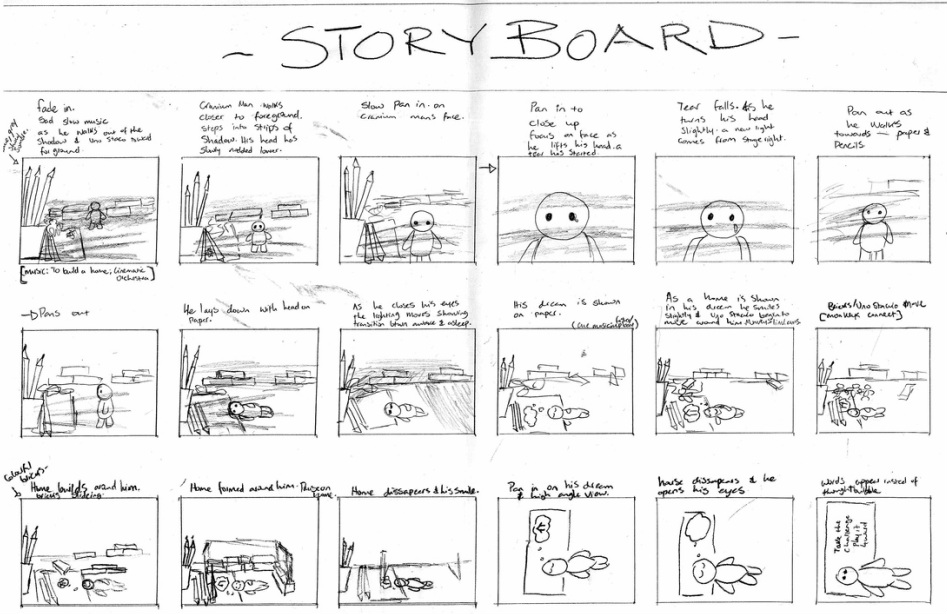
  4. Never underestimate the importance of a detailed story board. If students don’t think through their whole process while storyboarding they are going to struggle when making props and shooting pictures. The groups that were the most successful with there final product had beautiful story boards and those that were not so successful had story boards that were not only extremely minimal in detail but also did not resemble the final product. Students with poorly detailed story boards quickly learned from their shortcomings and were sure to put more thought into the storyboarding process in there next animations.

    Ruth Emma Design
  5. When working on set design often have students look at what they are making though the camera lens to make sure it will fit properly.  Often times students will make props too small and they are not noticeable through the camera.  This makes size and scale extremely important.  Another common issue is that student often make props that will be animated but have not put thought into how to keep the prop stationary for the shooting process.  This is a big issue that needs to be properly thought out before they get to far into the construction of the props.
  6. When shooting your pictures students should all have different roles. One person should be behind the camera and direct and the others as puppetiers.  They can take turns in these roles but often times you will find that some people are better as the camera man and tend to get the job done faster. Another thing to always keep in mind when shooting is you light source.  Shadows and changing light sources can often be overlooked by students and need to be kept in the forefront of their mind because shadows are not usually noticeable until many pictures have all ready been taken.

In the end what helped students to understand some of these details of the process before making mistakes of there own was constant pre-critiquing.  We got in the habit of starting class with older student examples I had collected.  It was often very easy to pick out little ways these could be improved but most importantly students were able to see how important attention to detail is.

I hope that some of you will find this overview of my process, along with some tips peppered in, to be helpful.  I’m a firm believer in the many many skills that can be learned through the stop motion process but I won’t get into all of that right now.  Should you choose to get your hands dirty I wish you the best of luck.

Enjoy this super cute animation by some of my students.  This was the groups first dabble with the process.

My New Friend Pinterest

When I look back on my Coetail experiences I think there are several ways in which I have engaged in on-line communities and used them to help my professional growth. From the very beginning in course one I was introduced to readers and immediately got sucked into Digg.  There are so many different blogs out in the art world and art education world that I have been plugged into for the last two years.  As a result I am constantly discovering new artists that I am then in turn sharing with my students and colleagues. One Artist I recently discovered through my Digg reader on Colossal is Scott Blake. This was a great little video I showed my animation students when I was introducing the simple idea of flip books and stop motion.

In an attempt to take my online professional community one step further I set up a twitter account. I was hoping to begin to develop a community on twitter that would keep me informed and discovering new ideas. Unfortunately that hasn’t happened for me just yet.  I’m not giving up but it has yet to become a regular check in for me. One on-line community that has suddenly taken off for me though is pinterest.  It was all a little unexpected but as an art teacher it total make sense.

mkhmarketing
mkhmarketing

I’ve been viewing other peoples boards for a while now because they are constantly popping up when I am doing searches that might relate to a material or concepts that I’m preparing to teach in my room. Earlier this year I finally decided that it was time for me to start making my own boards on pinterest. The plan was to simply have a holding space for things that influence me or ideas that I might want to revisit for a future lesson.

What surprised me shortly after I set up my account was how many people I knew were suddenly following me.  Many of these people are artists and art educators that I have know or come into contact with professionally or academically at some point.  I have loved seeing what types of things some of my previous colleagues have been pinning.  Some of them are even creating boards for specific classes where students can also share images on subjects that inspire them.  I love this idea and would like to explore it in some of my future classes.

Screen Shot of a pinterest board I share with a colleague.

The most exciting discovery for me though with my new interest in pinterest has been the ability to share images with my current colleagues.  The other art teachers that I currently work with are also on pinterest and we are all constantly pining images on each others boards that are related to conversations and units that we are currently engrossed in.  My colleague Michael and I teach different sections of the same class.  We have been doing some redesigning of our classes this semester and pinterest has become a great communication tool for us to share images. We often share ideas we feel we could use in class or use to help guide the design of our units. I have to say that this use of pinterest has been an unexpected and very pleasant surprise.

I do hope to get back to my abandoned twitter account at some point but for now I think I would like to work on nurturing this new found community in pinterest and explore its possibilities.


Ready, Set, Flip!

Photo accredited to Ilana Bressler

As I head into my final COETAIL course I am excited to experiment with flipping some of my lessons in my Intro to Art class. This particular class is very much focused on helping students to build their observation and drawing skills. In this course there are many little tricks that I teach my students in order to help them slow down and become better at observing. At times teaching these tricks can be a bit confusing in a live setting.  From time to time when I am giving a live demonstration students are asked to pay attention to my drawing that is being projected, the object I am drawing somewhere in the room, and listen to what I am saying. This can cause the students to practically become dizzy as they direct their attention from me to the screen to the object. Although it is usually not too much for most of my students to handle it all depends on the lesson and the kids in the class.

This is where I started to imagine how occasionally flipping my lessons might help the students to stay more focused and hopefully retain more of what I am saying. If I use a simple split screen and talk over the video I can easily eliminate all of the focus obstacles that so often take place during my lesson.

I want to flip a couple of lessons in this class to see if there is any noticeable difference in the product that students develop. I’m hoping to see better understanding of the concepts being taught. I will be looking to see if more or less students are demonstrating understanding. I am also curious to see if the quality of the work changes.  I am hoping to have more in class time for my students to work due to the fact that they will be watching my demo at home.   Will this help the quality to go up and go down? They will also have a device in front of them to review the lesson if needed.  This could also help for quality and understanding. These are not the only factors that could change in my classroom as I begin to flip lessons. Although these are things  that I will be looking at first and foremost. I will also be sure to take note of other changes that occurred in the lesson due to the flip. I went into a little more detail about why and how I will flip my classroom Final Unit for course 4. Now it’s time to get rolling.

Drawing on the Flipped Side of your Brain.

Da Vinci HeadAs I have been going over the content of course 4 and reflecting on it though my blogs and others the topic that sticks out the most to me is the idea of the flipped classroom.  I pointed out in one of my previous posts reasons as to why I think this would be relatively helpful and at times easy for me to implements as an art teacher.

The top 4 reasons I’d like to flip:

  1. Flipping would save class instruction time and give students more time for their art which is always a top priority for my class time.
  2. Students would be able to review my instructions as often as they like.  This would also help give me more time to help students who are needing further clarity or wish to extend themselves.  At the moment a lot of my one on one time is spent simply repeating things from my demonstrations, videos for review would eliminate this repetition.
  3. Flipping lesson would give me a platform to introduce deeper concepts that sometimes get cut out of my lessons because we are short on time. I could easily introduce other concepts and bits of art history to give students more background on our current subject matters.
  4. Demonstration videos would be very easy to make since I am already doing many of them under a demo camera at the moment. With technology I can easily enhance them when appropriate.

As I have been reading through articles and other blogs I have come to realize that there are many other possible benefits to flipping the 4 I have mentioned.  I’m excited to see if these four possible benefits are noticeable once I have flipped a lesson or two.  I’m also curious to see what other types of benefits or possible setbacks may occur in the process.

I have decided to focus on simply flipping a lesson or two to start.  As I was reading Jon Bergman’s article on Flipping the Elementary Classroom, several ideas for flipped lessons came to mind. Bergman says to start will a lesson instead of a whole unit or class, and that you should pick one the historically students have struggled with.  When I read this a lesson on negative space that I have done many times immediately came to mind.

Looking Back: My lesson on negative space is a drawing exercise.  This particular lesson focuses on one of many exercises that I have taken from Betty Edwards and Drawing on the Right side of the Brain. Students draw the negative spaces around a stool so that when they are finished they end up with a well proportions outline of a stool.  It sounds simple when I type it out but it is actually very difficult because our eyes are not trained to look for negative spaces. I find this exercise to be incredibly helpful and it immensely helps student to find better proportion in there art work.  The problem is that I often find the demonstration of drawing negative space to be rather confusing for many of the students. I end up spending a lot of class time working with kids one on one to find the negative spaces and I rarely have enough time to get to everyone.

Looking Forward: Flipping the instruction for this class could be very beneficial for my students.  Technology could greatly enhance my demonstration.  When I do this lesson in class I often put a stool up on a table for everyone to see and then under my demonstration camera I draw the negative spaces and talk through it. A video demonstration for students to view on their own could look very different. I could use a split screen effect with a photo of the stool on one side of the screen and then a video of me drawing on the other side.  This way students can easily see the two side by side This is a big improvement over the live version in class where they have to look back and forth.  Another bonus to making a video for this demonstration is that I could easily draw on top of the photo using Explain Everything and show the students the negative space in a way that I haven’t been able to in the past.

Screen Shot 2015-01-05 at 8.22.17 PMIMG_0318


Prior to the demonstration portion of the video I can show different examples of positive and negative spaces in other artwork to help explain the keep concept.  I’m hoping that this new use of technology will further enhance students understand of the concept as well as more clearly explain the exercise so that they can easily jump into practicing.

To be sure that my students have taken the time to watch the flipped videos I will have a small drawing assignment for them to complete in their sketchbooks. The drawing assignment will be a sort of entry ticket into class, if they haven’t watched the video they will have to do so in class, taking away from their work time. This short sketching assignment will also give them a little practice with the exercise being taught and at times will become the beginning stages of another assignment down the road.

I plan on flipping a couple of other lessons as well in the same manner.  Each focuses on drawing exercise for the same class.  If all goes well I hope to continue to develop flipped lessons for some of my other classes.  Since the class I am focusing on is mostly a drawing class my videos will be mostly tutorial.  Other videos for other classes could easily give more insight into art history and deeper artistic concepts as well.  This is my ultimate goal,  flipping lessons, units and eventually classes.  Hoping to free up more time in class for critiques, discussions and more than anything, creating.


What’s your problem?

As I was doing a little research into problem based learning, also know as PBL, I quickly found myself watching videos and reading articles about project based learning, also PBL.  Soon enough I lost track of whether or not I was trying to learn about ProblemBL or ProjectBL.  I began to wonder whether or not this was a common issue and what really was the difference between the two.  I actually found this very helpful chart from Edutopia that helps to spell it all out for me.

As you can see there are a lot of similarities between the two teaching methods. Both strategies seem to engage students in independent and collaborative problem solving skills. They actually seem to be more alike than different, I think the changes come in the actual problem that is being looked at.  As an art teacher I see a lot more potential for the arts being a part of project based learning rather than problem based learning.  With project based learning there is a final product that is often constructed some how.  This may not always be the case with problem based learning because it is more often than not linked to a single subject matter.  I could see problem based learning being easily applicable to a design class, where real design problems are presented but with project based learning we wouldn’t be limited to only design problems, we would have a larger array of artistic avenues to present our findings because it would often be interdisciplinary.

Project based learning actually reminds me of STEAM (better know as STEM). STEM is project based learning that incorporates Science, Technology, Engineering and Math into one problem. STEAM integrates the arts into that same problem. Often times STEAM can lend itself to functional design problems but it is not limited to that.  I once taught at a school where we helped the kids to present their STEM findings through artistic expressions.  Our presentations involved art installations, dance, song, light shows and instrumental performances.  Often times several artistic elements were combined to help present students findings.  It was exciting to see these types of problems be presented in such artistic and expressive ways.

 STEAM isn’t the only application of project based learning that is possible for art teachers though. Art is a project driven subject, the challenge for the teacher is to find the real world problems to apply. I think this could be the challenge for many teachers.  Finding the problems.  We need to be finding the problems with the students.  That is where these projects need to start and I’m not so sure that problem based learning is helping the kids to come up with the problem.  I think it is helping in many other areas but it is also important the the problem presented art of interest to the student and that they are real problems. I suppose that STEAM always helping kids come up with the problems either.  Usually the problem is presented and the students try to solve it.

How can we help the students to find the problems? This is where I look at art from another lens.  That is one of the things I love about the arts is how versatile it is.  From one artistic lens we can use art to help us solve problems like in the cases of functional design and STEM.  With another artistic lens we can use art to help point out the problems.  Artist are asking hard questions all the time and expressing their findings and wonderings about the world. Maybe we need to start looking to artists to help find the problems more often.  Contemporary artist are showing us the problems in their own way.  We need to be observing first in order to start any problem solving. Observation then enquiry, as an artist that is one thing I know for certain.

Here is a contemporary piece done by the Spanish Art collective Luzinterruptus exactly what I’m talking about.  Observing, wondering and showing us problems our world.  This could be a good place to insert a few questions.

Make Meaning, Connect, Reflect, Repeat.

As I was reading over some of the course materials on connectivism I noticed different concepts and themes repeated throughout the material.  Words like motivation, self direction, autonomy, purpose, challenge and personal interest often reoccured.  Dan Pink, author of Drive: A suprising truth about what motivates us, talked about many of these themes. Most of the time these themes were in reference to new business models but it is actually much bigger than that.  Is it possible that there are some new business models out there that, dare I say it, the educational system can learn from?

Earlier this week I was having a conversation with some colleagues about good leadership. In our conversation we discussed leaders who often ask for input before making decisions.  Good leaders have that type of confidence in the collaboration of their team members.  Within that mind set a good leader trusts there team and gives them a certain amount of autonomy. This can be a very empowering thing for an individual that can in turn create passion, drive and purpose in their work.

The recent course material also got me thinking about my husbands “down time” activities this weekend.  He chose to spend the majority of his time rebuilding a website for a local NGO that he occasionally volunteers for.  He has a skill that he enjoys building on and applying but always with meaning.  The meaning is a key piece of the puzzle, it’s a big part of what drives him.

In my classroom I’m always trying to stay focused on meaningful art making for my students.  I have found myself getting closer and closer to that the last few years and the variety of work that my students turn out is amazing.  When I say meaningful art making I mean art making that is personal, students have some autonomy in the what and/or how.  I can provide a framework in order to help them create and reflect in the same way that artist create and reflect on culture and society.  This isn’t just in the art room though, students should be creating and reflecting everywhere, project based learning, with real ownership to create real investment. I first started looking at the art room this way when I was introduced to Olivia Gude, Artist and Educator at University of Illinois in Chicago.  In her article: Rubric for a quality art curriculum she states that  “A curriculum is not only a structure for the dissemination of knowledge; the structure and content of the curriculum also involves the production of knowledge.“  Isn’t this what we are talking about when we are talking about connectivity? Curriculum involving the production of knowledge,? https://pixabay.com/p-96100/?no_redirectPrior to being introduced to some of her educational philosophies, I didn’t realize it, but there was very little connection to the way my students were creating art and the way artists in the outside world were creating art.  In an art room that possesses some of these themes mentioned before, self direction, autonomy, mastery, purpose, challenge and personal interest, students are expressing their ideas, building their skills and exposing one another to different opinions. In a classroom where real meaning making is happening connectivism is happening.  The addition of the internet blows those connections sky high.  We are no longer confined to learning from only our classmates and our teachers.  We are now able to learn from others around the world because of current technology. This is amazing but we must hold onto the the meaning making and always focus on helping students to reach for that.  Allowing a place for students to creating meaning in their work will require our good leadership.


Flipping = More making

Image attributed to Jeff DalyI have to say the idea of a flipped classroom really appeals to me as an art teacher.  There’s always so much that I would like to cover in order to give my students background knowledge and teach technique but the more time I take demonstrating and discussing art the less time students have to create and the creative process is my top priority.  I remember  very clearly when I was in school, it always seemed as though our art teacher couldn’t finish talking fast enough. We just wanted to get back to work.  I often try to remember this when teaching my own classes.  Listening to me do demonstrations is helpful and necessary but it also eats up work time for projects that simply can’t be done at home.  Taking the time to flip my classroom could have many benefits to it.

First and foremost recording my demonstrations for kids to watch at home will buy them more time in class to create. This should be relatively easy for me. I’m already demonstrating under a document camera.  I even record my demonstrations from time to time so that I can loop them on the screen while kids are working. I only need to take it one tiny step further. This will also have an added benefit for kids who are absent.  With the way things are now kids I often have to work very closely with kids who were absent in order to help them get caught up.  If my demonstrations were posted then students wouldn’t be waiting on me to help them get caught up.  Other students would also have the ability to re watch demonstrations if they need to look back. Helping eliminate the need for me to repeat myself.

Secondly, most of my demonstrations are fairly short  This means that I could easily add onto some of my demonstrations by introducing other artists, artistic concepts or additional  background.  I’m always wanting to give students a wider variety of content that can help encourage their own creative ideas and processes. Unfortunately this is the part of my class that often gets cut short so that students have more time to create.  With a flipped classroom I can easily tack on little bits of content along the way with my demonstration videos.

Lastly, with a flipped classroom I can eliminate some of the discipline problems that come along with trying to gather everyone and quiet them down for demonstrations.  Although discipline isn’t a big issue in my class it can eat up little bits of time here and there.  If I don’t have to give so many demonstrations and kids watch them on their own we would not only be saving work time but kids won’t be distracted by other kids when they should be watching what I’m doing.

In conclusion I would really like for this to be a new focus for me as I move into next year and even a bit next semester. The first steps should be easy.  Right now some of my biggest questions moving forward is how to begin organizing all of my information and videos.  The Herreid and Schiller case study on flipped classrooms offers lot of great suggestions for shooting videos and posting them.  I hope to do a little research into that for some direction.  If any others out there have any tips on how they shoot videos for demonstrations or organize their content I would love to hear about it.


Reflection Time

As I read through the course material for week 1 of course 4 I’ve been asking myself a lot of questions about the type of technology I use and where do I fall on the TPACK framework or SAMR model.  One reading that particularly caught my interests was Jeff Utecht’s blog post on evaluating our technology use in the classroom. I thought it would be worth my while to give myself a little evaluation.  Over the course of one 8 block cycle I kept a log of all the different ways that technology was being used in my classes.  Many of my classes are using technology in similar ways. Using Jeff’s evaluations questions I would say that most of the technology used in my classroom fall’s between “using technology to do old things in new ways” and “technology creating new and different learning experiences for the students”.

I would have to admit that most of what we are doing is probably closer to the “using technology to do old things in new ways” category.  Here are some examples from my classes.

    1. A Daily Prezi: I keep a rather detailed prezi as a scope and sequence for all of my classes.  This is a nice little daily overview of what we will be doing for the period as well as outcomes.  I like to project this up for the period so that students can refer back to it as needed.  It is also a nice way for me to keep any videos, pictures or other information linked to the lesson right there with my scope and sequence. Giving the kids a daily overview of the class schedule and outcomes is nothing new but prezi has provided me with a better way of organizing large amounts of information as I move from class to class. I have yet to do this but prezi can also be shared online.  I have often wondered if it would be helpful to students to have access to my prezis so they can look back at what we covered or get a glimpse of what they missed when absent.
    2. Google Slides Portfolio: New to my classroom this year are online portfolios.  Instead of using a portfolio website I have decided to use google slides.  The reason for this is that the student and I can share the slide presentation which makes is easy for me to comment and help edit. It’s also nicely organized through hapara. The third reason I like to use this format is so that I can embed all of my students portfolios onto my blog.  This has been a great way for students to view others work and furthermore for parents to view student work. Presentation is a very important part of any art class and this format has allowed me to take it to another level without always hanging work in the halls.  Here is an example of a student portfolio from my art Studio Class.

I could go on through my list of ways we are using technology in the classroom but I think I will stop there for now.  These two example stick out to me because they are being used on a daily basis. I would love to hear some of your thought on these practices.  Where do you think these practices lie on some of the models discussed in Course 4?  Do you have any ideas as to how they could be brought to the next level?  These are practices that I see myself continuing to implement and smooth out over the next year. I would love to hear your feedback.